Today I saw the movie Alexander. The battle scenes are shot well, especially the conquest of Babylon. However, it's a three-hour long movie that oftentimes seems like some documentry on Alexander's life rather than a movie. There are two things that one realizes on seeing the movie. First is Alexander's unprecedented military success. The second is his failure of conquest of India.
It was India that first broke the will of his army and then Alexander's own will to fight. For the first time Alexander's forces were opposed by armies mounted on twenty-feet tall elephants that instilled mortal fear in them. Alexander tried hard to motivate them, but after bloody battles in dense and trecherous forests, his own resolve weakened. He gave up his dream of conquering the world and declared, "We will not go futher. We will go back all the way to Macedonia".
The movie tells us that it was only India that he failed to conquer. Unfortunately we are not told the story this way. We are only taught about Alexander's victory over King Puru (or Porus as the Greeks called him). We consider Alexander as our conquerer. Because Indian history is written by people who have no pride in this great nation and her achievements. That is why we are not told to be proud of Alexander's failure to conquer India and Chandragupta Maurya's subsequent unification of our country from Khadahar to Bengal.
It was India that first broke the will of his army and then Alexander's own will to fight. For the first time Alexander's forces were opposed by armies mounted on twenty-feet tall elephants that instilled mortal fear in them. Alexander tried hard to motivate them, but after bloody battles in dense and trecherous forests, his own resolve weakened. He gave up his dream of conquering the world and declared, "We will not go futher. We will go back all the way to Macedonia".
The movie tells us that it was only India that he failed to conquer. Unfortunately we are not told the story this way. We are only taught about Alexander's victory over King Puru (or Porus as the Greeks called him). We consider Alexander as our conquerer. Because Indian history is written by people who have no pride in this great nation and her achievements. That is why we are not told to be proud of Alexander's failure to conquer India and Chandragupta Maurya's subsequent unification of our country from Khadahar to Bengal.


Tsunami toll rises to 1,16,000. This is UNimaginable and unprecedented! So unbelievably shocking!
Chandragupta's friend Atul Dighe was at Vivekanand Rock Memorial in Kanya Kumari when the Tsunami struck Indian coast. Thankfully the statue sheltered everybody.
Chandragupta's friend Atul Dighe was at Vivekanand Rock Memorial in Kanya Kumari when the Tsunami struck Indian coast. Thankfully the statue sheltered everybody.
Fatigue taking it's toll
Now that it has become a habit to miss the company bus and go to Suwon by train later, I felt no qualms doing that today. What surprised me was that, as the train pulled into Suwon station, I had to make an effort to get up from my seat and head out. Later in the day at some point, a thought crossed my mind, "I can't do this task any further". I have never said this to myself in several months. Exhaustion is now slowly taking it's toll on me.
Yesterday I reached home after 2 a.m. Productivity hasn't been good for the past two days. Often in the last two weeks, I have counted how many more days to go, here in Korea. I see many of my colleagues frequently counting down days, but I never do that, because impatience breeds on itself. So, I was surprised at what I was thinking.
Next ten days are going to be crucial. And it's going to get worse before it gets better. In past, I have taken wrong actions under stress and exhaution. I realise that I need to stay calm at this point of time. I am not the only one under duress. Everyone is under pressure to deliver. Others would be reacting to my actions under stress of their own. So I need to be extra careful. I need to understand my own state of mind as well as that of others. I am supposed to be good at staying calm under pressure. This would be yet another test for me.
What's killing me is lack of diversion. I haven't opened a book in last three weeks! May be I should try to find some time to read even in these busy days. It may help relax my mind.
One reason why Swami Vivekanand's writings has such a tremendous influence on my thoughts and my actions is that again and again I find that I am never in a situation where I do not have his suggestions to guide me. As I think about my present difficulties, I am reminded of what I read last week - "Best work is only done by alternate repose and work". Keeping this in mind would help.
I knew this month was going to be hectic. But I never thought it would be so hectic. First, I started sitting late and started taking the last bus from Suwon to Seoul. But this week, even that seemed too early. Most of the days I have been leaving house at around 7 or 8 a.m and returning after midnight. Today Korean courtesy forced me to go come home early (i.e. at 9:30 p.m). "We won't feel comfortable if you work alone and we all go home early to celebrate Christmas eve. So please, let's go home!" The only thing that spoils the mood after such a beautifully satisfying week and two days of great holidays to look forward to, is today's discovery of an "issue" that may hit us hard, with just a week to go-live. I would like to forget it and enjoy my weekend (knowing that I got a shorter weekend last time). However I don't know whether I would be able to do that. We often complain about our not being able to remember things when we need. I think it's a bigger problem when we ain't able to forget things that we want to forget!

In the first, Chandrayaan-1 will map the Moon’s topography with a 3D terrain mapping stereo camera capable of imaging the lunar surface in black and white. Useful, because ‘‘future developments on the moon will need an accurate base map,’’ says George Joseph, chairman, Chandrayaan-1 science advisory board. India’s other lunar objectives:
• Study origin, evolution, mass concentration of Moon
• Chemical, mineral composition of Moon
• Search for Helium-3 as potential energy resource
• Probe trapped, frozen water
• 10-15 kg payload of foreign experiments

Yesterday, Viswanath, Adhip, Veera and I went for bowling first time in Korea. It was fun great fun, especially the second game. Viswanath and I were paired in lane number 4. I took an early lead, bowling all the pins in the first throw. I maintained my lead till round number 6. But brilliant as he is, Viswanath came back from behind bowling all pins in three consecutive rounds - 6, 7 & 8. After the eight rounds I was trailing at 84 and Vis at 95+. I knew I need a miracle in the last two rounds to win. As I took position for the nineth round I was determined to concentrate well. I downed all the pins in the first shot, that took me to 94 plus the bonus at hand in round 10. I repeated the feat in the first throw of the tenth round to take me to 114. In the next throw one corner pin betrayed me and stood there while it's fellow pins were bowled down. In the bonus third throw in last round I had to hit the lone conermost pin, which is probably more difficult as putting down all ten in one throw. I threw the ball from one feet away from the edge with a slight angle. Half way through the lane I realised that the ball was head straight to towards the pin. And yes, it did bring it down without ever being under the risk of sliding into the gutter! I ended with a score of 134. A whopping 50 points scrored in the last two rounds!! Viswanath ended with a score of 128. In the neighbouring lane, Adhip and Veera tallied 67 and 64 respectively. Adhip quickly observed that our scores were exactly double their scores. It was surely the highest scoring and the most exciting game of bowling I have ever played!
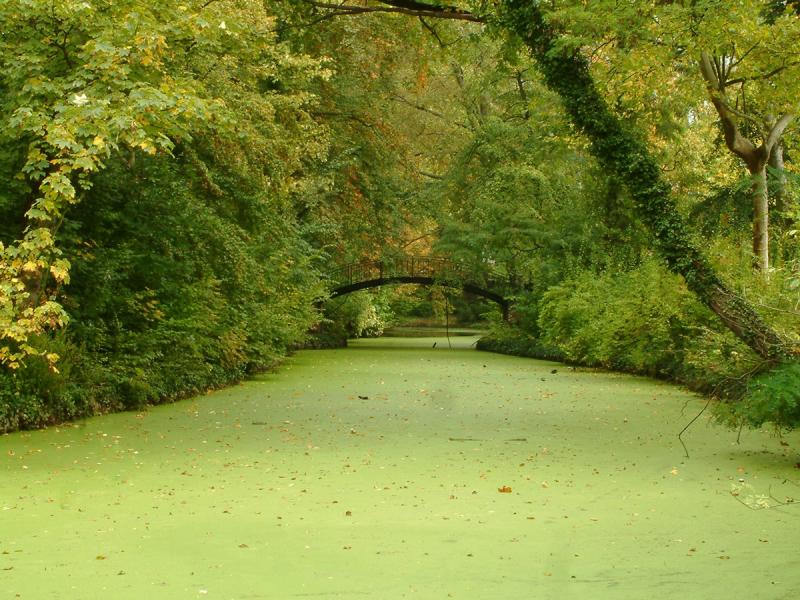


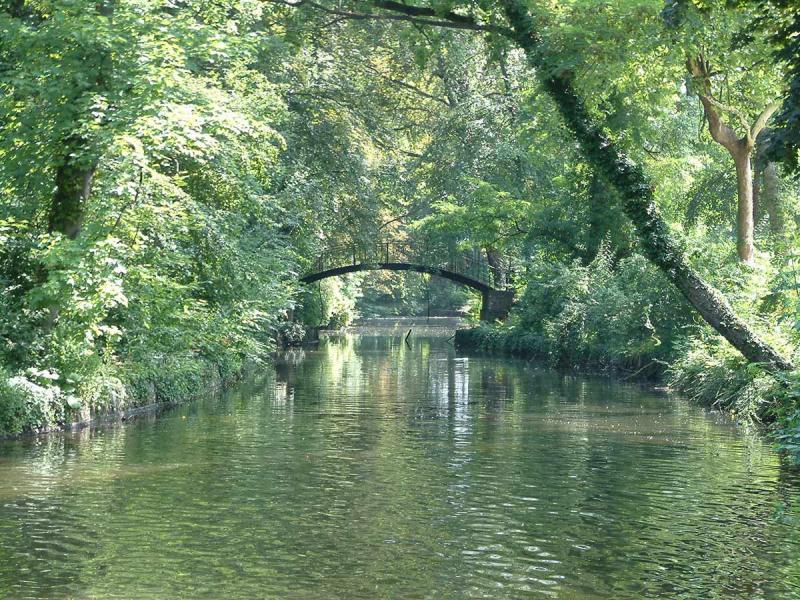
Quote for these ... rather all days
No man can always be right. So the struggle is to do one's best, to keep the brain and conscience clear, never to be swayed by unworthy motives or inconsequential reasons, but to strive to unearth the basic factors involved, then do one's duty.
- Dwight D. Eisenhower
No man can always be right. So the struggle is to do one's best, to keep the brain and conscience clear, never to be swayed by unworthy motives or inconsequential reasons, but to strive to unearth the basic factors involved, then do one's duty.
- Dwight D. Eisenhower
Labels:
Quotation

Half of America apologises to the rest of the world!!
"Some of us — hopefully most of us — are trying to understand and appreciate the effect our recent election will have on you, the citizens of the rest of the world. As our so-called leaders redouble their efforts to screw you over, please remember that some of us — hopefully most of us — are truly, truly sorry. And we'll say we're sorry, even on the behalf of the ones who aren't".
- www.sorryeverybody.com
"Some of us — hopefully most of us — are trying to understand and appreciate the effect our recent election will have on you, the citizens of the rest of the world. As our so-called leaders redouble their efforts to screw you over, please remember that some of us — hopefully most of us — are truly, truly sorry. And we'll say we're sorry, even on the behalf of the ones who aren't".
- www.sorryeverybody.com
Excerpts from another good article on the shankarAchArya episode, by Shobha Vasudevan:
All the articles that holler about the 'high profile' pontiff do not devote any newsprint to how he has utilised his position of authority. Jayendra Saraswathi, after taking over as the Shankaracharya, is singularly responsible for opening 55 schools and a string of hospitals, professional colleges, child care centres and universities throughout the country. The services in these institutions are offered free of charge or at subsidised rates, and benefit large sections of society. In addition, charitable trusts for aiding poor families, old-age homes, rural development trusts, food donation projects, and research projects have also been flagged off by the acharya.
All the articles that holler about the 'high profile' pontiff do not devote any newsprint to how he has utilised his position of authority. Jayendra Saraswathi, after taking over as the Shankaracharya, is singularly responsible for opening 55 schools and a string of hospitals, professional colleges, child care centres and universities throughout the country. The services in these institutions are offered free of charge or at subsidised rates, and benefit large sections of society. In addition, charitable trusts for aiding poor families, old-age homes, rural development trusts, food donation projects, and research projects have also been flagged off by the acharya.
A good article on shankarAchArya's arrest.
I think the shankarAchArya's arrest is not only unacceptable, but an unpardonable offence.
I think the shankarAchArya's arrest is not only unacceptable, but an unpardonable offence.
The Golden Mile of Iteawon
Iteawon (pronounced as itavAn) is Seoul's equivalent of MG road-Brigade road. About 1.2 kms in lenght it is the most happening place in Seoul Saturday nights. At one end of the road is US military base. Every weekend US come out of their base to pub and party. It also has a large number of foreign restaurants. For us Indians the main attraction at Iteawon is Indian food! There are three Indian hotels at Iteawon which we visit invariably on weekends.
Labels:
Korea
A Golden Leaf from Indian History
Chandragupta Maurya (322-298 BC) was the first emperor of the Mauryan empire. Alexander's invasion prompted Indians to develop a centralised state. Chandragupta came to rule much of North India. He rose to power under the influence of a minister named Chanakya, and with his assistance, overthrew the last of the Nanda kings of Magadha and captured their capital city of Pataliputa. He then turned his attention to northwestern India where a power vacuum had been left by the departure of Alexander. The way in which he carried himself and the way he ruled seems like a mirror image of Alexander. He conquered the lands east of the Indus River and then, moving south, took over much of what is now Central India.
The year 305 BC saw Chandragupta back in the Northwest, where Seleucus I Nicator, the Macedonian satrap of Babylonia, was threatening fresh invasions. Chandragupta not only stopped his advance but pushed the frontier farther west into what is now Afghanistan. Along with the the astute advice of Chanakya, Chandragupta seized Punjab, Kabul, Khandahar, Gandhara and Persia from Seluces. Selucus had to conclude a treaty with Chandragupta by which he surrendered a large territory including, in the opinion of certain writers, the satrapies of Paropanisadai (Kabul), Aria (Herat), Arachosia (Qanadahar) and Gedrosia (Baluchistan), in return for 500 elephants. The treaty was cemented by a marriage contract - Seluces' daughter was married to Chandragupta. Chandragupta's fame spread far and wide and his empire was recognised as a great power in the western countries. The kings of Egypt and Syria sent ambassadors to the Mauryan Court.

Maurya empire was the first really large and powerful centralised state in India. It was very well governed, with tempered autocracy at the top and democracy at the city and village levels. Megasthenes, the Greek ambassador at the court of Chandragupta Maurya in Pataliputra, had expressed his admiration for the efficient administration of the empire. Megasthenes wrote about the prosperity of the Mauryan cities. He further reported that agriculture was healthy, water abundant and mineral wealth was in plenty. Speaking of the general prosperity, Megasthenes wrote, "the Indians, dressed in bright and rich colors, they liberally used ornaments and gems."
He also spoke of the division of society according to occupation and the large number of religious sects and foreigners in the empire. The people were divided into seven endogamous groups--"philosophers", peasants, herdsmen, traders, soldiers, government officials, and councilors. The army was composed of the four traditional Indian divisions: forces mounted on elephants, on chariots, cavalry, and infantry, and tended to be large - Chandragupta's forces numbered 600,000 men.
The religious life of the empire may perhaps best be characterized as pluralistic. Brahamanism, Buddhism, Jainism, the Ajivikas, and wandering mendicants of other types all seem to have coexisted side by side. The general religious policy of the Mauryas was to encourage tolerance.
Under Mauryas empire the Indian subcontinent saw, for the first time in history, a considerable degree of political unity. The empire was very strong and independent because it had some kind of political unity. In modern times the Maurya Empire is remembered as one of the golden ages of Indian history, a time when the country was united and independent.
Links:
brainyencyclopedia.com
indhistory.com
The year 305 BC saw Chandragupta back in the Northwest, where Seleucus I Nicator, the Macedonian satrap of Babylonia, was threatening fresh invasions. Chandragupta not only stopped his advance but pushed the frontier farther west into what is now Afghanistan. Along with the the astute advice of Chanakya, Chandragupta seized Punjab, Kabul, Khandahar, Gandhara and Persia from Seluces. Selucus had to conclude a treaty with Chandragupta by which he surrendered a large territory including, in the opinion of certain writers, the satrapies of Paropanisadai (Kabul), Aria (Herat), Arachosia (Qanadahar) and Gedrosia (Baluchistan), in return for 500 elephants. The treaty was cemented by a marriage contract - Seluces' daughter was married to Chandragupta. Chandragupta's fame spread far and wide and his empire was recognised as a great power in the western countries. The kings of Egypt and Syria sent ambassadors to the Mauryan Court.

Maurya empire was the first really large and powerful centralised state in India. It was very well governed, with tempered autocracy at the top and democracy at the city and village levels. Megasthenes, the Greek ambassador at the court of Chandragupta Maurya in Pataliputra, had expressed his admiration for the efficient administration of the empire. Megasthenes wrote about the prosperity of the Mauryan cities. He further reported that agriculture was healthy, water abundant and mineral wealth was in plenty. Speaking of the general prosperity, Megasthenes wrote, "the Indians, dressed in bright and rich colors, they liberally used ornaments and gems."
He also spoke of the division of society according to occupation and the large number of religious sects and foreigners in the empire. The people were divided into seven endogamous groups--"philosophers", peasants, herdsmen, traders, soldiers, government officials, and councilors. The army was composed of the four traditional Indian divisions: forces mounted on elephants, on chariots, cavalry, and infantry, and tended to be large - Chandragupta's forces numbered 600,000 men.
The religious life of the empire may perhaps best be characterized as pluralistic. Brahamanism, Buddhism, Jainism, the Ajivikas, and wandering mendicants of other types all seem to have coexisted side by side. The general religious policy of the Mauryas was to encourage tolerance.
Under Mauryas empire the Indian subcontinent saw, for the first time in history, a considerable degree of political unity. The empire was very strong and independent because it had some kind of political unity. In modern times the Maurya Empire is remembered as one of the golden ages of Indian history, a time when the country was united and independent.
Links:
brainyencyclopedia.com
indhistory.com
For some people in our country, it doesn't matter so much the accused is really guilty or innocent as to what religion he belongs. Some months back I was disgusted when I read that an NGO by the name "Combating Communalism" and the lady behind it Teesta Seetalvad was working hard for acquittal of Godhra accused. Now the chief witness has accused the very same people of forcing her to give false testimony in the Best Bakery case in order to convict accused who she are in fact innocent!
Inspiring Capsules from Vivekanand
I have been associated with a group of friends who are dedicated to the cause of spreading the message of Swami Vivekanand. One of the members frequently sends quotations from Vivekanand's writings on our e-group. Here's one of his mails ... truely inspiring!
On Work
1. It is better to wear out than to rust out.
2. Whenever you promise to do any work, you must do it exactly at the appointed time, or people lose their faith in you.
3. Whatever one has to do, one must apply to it one’s whole attention and energy for the time being. Pavhari Baba of Ghazipur would clean his brass water vessel with the same undivided attention as he used in his meditation, japa, worship, study, etc. He cleaned it so diligently that it shone like gold. He himself being the best example of the secret he once told us of work, "the means should be loved and cared for as if it were the end itself."
4. We must plunge heart and soul and body into the work. And until we be ready to sacrifice everything else to one idea and to one alone, we never, never will see the Light.
5. Great Enterprise, boundless courage, tremendous energy and, above all perfect obedience - these are the only traits that lead to individual and national regeneration.
6. Even the greatest fool can accomplish a task if it takes after his heart. But the intelligent man is he who can convert every work into one that suits his taste. No work is pretty. Everything in this world is like a banyan-seed, which, though appearing tiny as a mustard seed, has yet the gigantic banyan tree latent within it. He indeed is intelligent who notices this and succeeds in making all works truly great.
7. All work is spoilt by dilatoriness.
8. Best work is only done by alternate repose and work.
9. One who wastes one’s energy in dabbling in other people’s affairs and in other aimless activities can hardly have any energy left for performing a desirable duty. The sum total of the energy that can be exhibited by a person is a fixed quantity. As such, if it finds an outlet in useless way, it can no further be drawn on for any purposeful activity. One requires tremendous energy to realize the deeper truths of religion. That is why the religious books of all races advice the aspirants not to waste their energy in the enjoyments of sense-objects, but to preserve it through continence and other means.
10. About works also, it should be understood that nobody can wholly avoid doing something or other, and no work can be either good or wholly bad. If you undertake a good work, you are bound to do some amount of bad work along with it. As a result, along with the happiness derived from the good work, some amount of unhappiness and dissatisfaction also will come inevitably. If you want to avoid that much of evil, you will have to give up the hope of deriving the apparent happiness from the sense-enjoyment, that is to say, you will have to give up all the selfish motives and go on doing your works out of a sense of duty. That is what is called ‘work without motive’ (selfless work) . While instructing Arjuna about this in the Gita, Shri Krishna says "Work, but dedicate its fruit to me , that is say, work for me."
11. Purity, patience and perseverance are the three essentials to success, and above all love. (this is my pet one!)
12. I like to work on calmly and silently, and the Lord is always with me. Follow me, if you will, by being intensely sincere, perfectly unselfish and above all, by being perfectly pure.
13. The wind is blowing; those vessels whose sails unfurled catch it, and go forward on their way, but those which have their sails furled do not catch the wind. Is that fault of the wind? Is it the fault of the Merciful father,whose wind of mercy is blowing without ceasing day and night, whose mercy knows no decay, is it His fault that some of us are happy and some are unhappy? We make our own destiny.
14. Whatever you do,let that be your worship for the time.
Having spent so much time on this, I am sure it's time for me to get back to work. :-)
On Work
1. It is better to wear out than to rust out.
2. Whenever you promise to do any work, you must do it exactly at the appointed time, or people lose their faith in you.
3. Whatever one has to do, one must apply to it one’s whole attention and energy for the time being. Pavhari Baba of Ghazipur would clean his brass water vessel with the same undivided attention as he used in his meditation, japa, worship, study, etc. He cleaned it so diligently that it shone like gold. He himself being the best example of the secret he once told us of work, "the means should be loved and cared for as if it were the end itself."
4. We must plunge heart and soul and body into the work. And until we be ready to sacrifice everything else to one idea and to one alone, we never, never will see the Light.
5. Great Enterprise, boundless courage, tremendous energy and, above all perfect obedience - these are the only traits that lead to individual and national regeneration.
6. Even the greatest fool can accomplish a task if it takes after his heart. But the intelligent man is he who can convert every work into one that suits his taste. No work is pretty. Everything in this world is like a banyan-seed, which, though appearing tiny as a mustard seed, has yet the gigantic banyan tree latent within it. He indeed is intelligent who notices this and succeeds in making all works truly great.
7. All work is spoilt by dilatoriness.
8. Best work is only done by alternate repose and work.
9. One who wastes one’s energy in dabbling in other people’s affairs and in other aimless activities can hardly have any energy left for performing a desirable duty. The sum total of the energy that can be exhibited by a person is a fixed quantity. As such, if it finds an outlet in useless way, it can no further be drawn on for any purposeful activity. One requires tremendous energy to realize the deeper truths of religion. That is why the religious books of all races advice the aspirants not to waste their energy in the enjoyments of sense-objects, but to preserve it through continence and other means.
10. About works also, it should be understood that nobody can wholly avoid doing something or other, and no work can be either good or wholly bad. If you undertake a good work, you are bound to do some amount of bad work along with it. As a result, along with the happiness derived from the good work, some amount of unhappiness and dissatisfaction also will come inevitably. If you want to avoid that much of evil, you will have to give up the hope of deriving the apparent happiness from the sense-enjoyment, that is to say, you will have to give up all the selfish motives and go on doing your works out of a sense of duty. That is what is called ‘work without motive’ (selfless work) . While instructing Arjuna about this in the Gita, Shri Krishna says "Work, but dedicate its fruit to me , that is say, work for me."
11. Purity, patience and perseverance are the three essentials to success, and above all love. (this is my pet one!)
12. I like to work on calmly and silently, and the Lord is always with me. Follow me, if you will, by being intensely sincere, perfectly unselfish and above all, by being perfectly pure.
13. The wind is blowing; those vessels whose sails unfurled catch it, and go forward on their way, but those which have their sails furled do not catch the wind. Is that fault of the wind? Is it the fault of the Merciful father,whose wind of mercy is blowing without ceasing day and night, whose mercy knows no decay, is it His fault that some of us are happy and some are unhappy? We make our own destiny.
14. Whatever you do,let that be your worship for the time.
Having spent so much time on this, I am sure it's time for me to get back to work. :-)
Labels:
Quotation,
Swami Vivekanand
Korea in Pictures - II
Seoul is surrounded by many mountains. One of those is


(Click to enlarge)
Kwanaksan
Kwanaksan is located in the south of Seoul. As I found out, it's a beautiful trek to the peak, which is about 600m above sea level. At the top there are beautiful Buddhist shrines more than thousand years old. Here are some of the pictures of the shrines.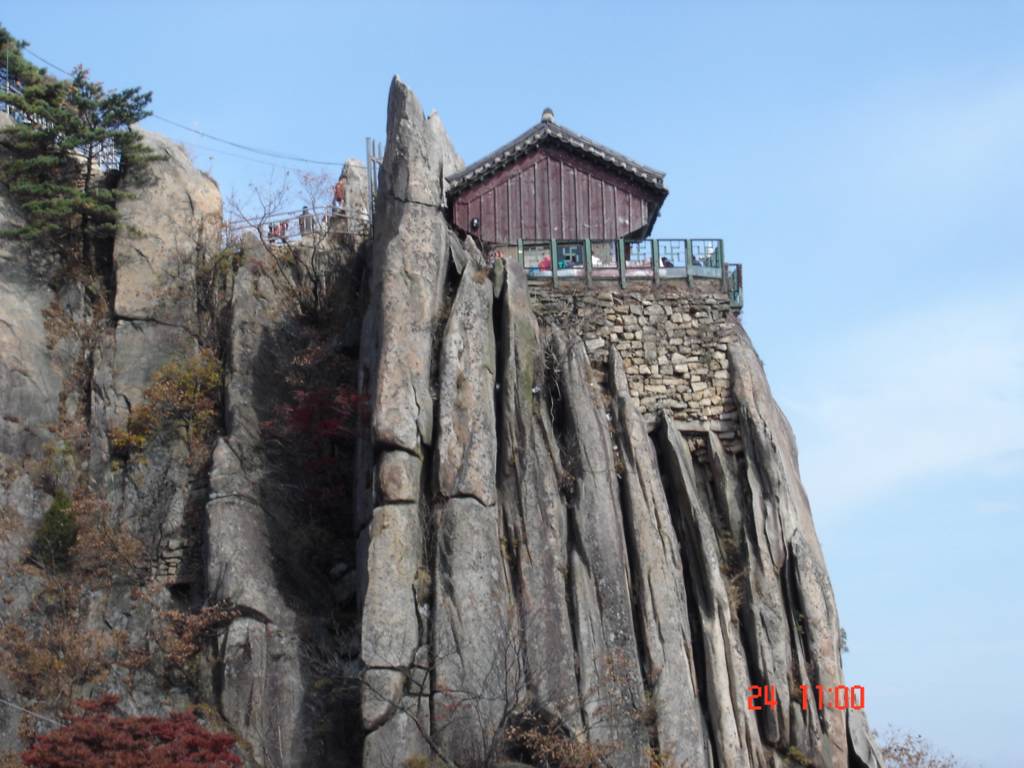

(Click to enlarge)
Korea in Pictures - I
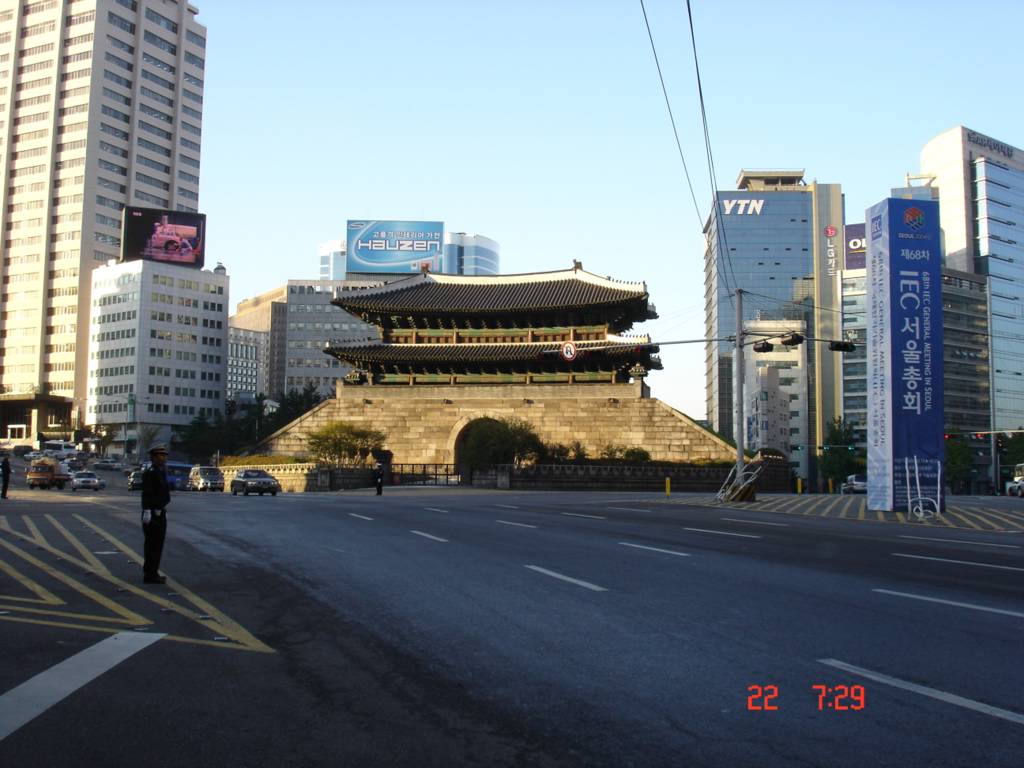
Here's the first in the series "Korea in Pictures". As they say, "a picture is worth a thousand words." It is much better for me to post pictures rather than just tell you about Korea. Although this first post is about one of the most important tourist destinations in Korea, my idea is not just to tell you about tourist places in Korea, but rather to show you everything that I have found interesting in my stay here - even the most ordinary things of day-to-day life. But first let me begin with one of the oldest and most important landmarks in Seoul.


Namdaemun
(pronounced as nAm-de-mun) or the "Great South Gate" is Korea's Treasure number 1. This wooden structure was constructed in 1398 and as the name suggests was the southern gate to the city of Seoul. Today it is in the heart of Downtown Seoul and you can see it is surrounded by skyscrapers.
This does not forebode good for our country
"Its [Maharashtra government's] five-year record in office was, by universal reckoning, pathetic. Short of communal riots, everything that could go wrong went wrong for it. For the Opposition, the anti-incumbency cocktail was heady and perfect. There was drought, farmer suicides, financial profligacy, indifferent development and high-profile corruption involving important Ministers".
Read more in BJP must retreat, introspect on samachar.com
"I am worried that a trend is setting in India where ability to govern and ability to get elected are getting disconnected. There is a mis-match between governance and electability. Good governance is not yielding you votes or poor governance is not influencing the other way", Arun Jaitley in Defeat stuns BJP's Delhi HQ on rediff.com


Talking about elections, Maharashtra goes to polls next week, and I am going to miss voting. I think there are two factors that would determine the results of the elections:
1. Infighting within the Congress-NCP
2. Bal Thakarey not campainging because of his ill health
Bal Thakarey is not getting any younger and it is time that the tenth rung of the party (there are no eight rungs in between) rises to the occasion. This election will be their first test.
Another important factor is whether non-Congress "secular" parties informally withdraw from the fray at the last moment and ask their voters to vote for a "secular" party. This has happened frequently in the past and I wonder whether it will happen this time.
gir gayaa to kyaa huaa, pair to upar hai!!
The CIA report released a couple of days back on the investigation of weapons of mass destruction allegedly possesed by Iraq concludes that Iraq did not posses any such weapons when the US invasion began nor did it have any programme to produce such weapons. This is a big smack on the face of those who advocated the war in Iraq. The reaction to the report from those supporting the war including Tony Blair has been that Saddam had "intentions" of making WMD and therefore the war was justified. In Mumbai slang this is termed as, "gir gayaa to kyaa huaa, pair to upar hai!" In plain English, it means stubbornly refusing to accept the plain and simple facts.
I hate war mongers. And I would love to see Bush and Blair defeated in their respective elections.

Of quotes and quotations
Quotation
Definition: A phrase or a sentence from a book or a speech that reflects the author's profound thoughts. Quotations can be amusing, interesting, thought provoking, sad, inspiring or emotional.
Quote
Definition: To quote means to repeat the exact words of another with the acknowledgement of the source.
Often the word quote is used as a substitute for the word quotation. Strictly speaking, this is incorrect. Quote is a verb and Quotation is a noun. So, in effect, you quote a quotation.
Found the above on http://quotations.about.com. Good one, right? I have found about.com as one of the most informative sites on the internet, on a diverse range of subjects.
Coming back to the title of this blog - today, I read a beautiful quote, oops, quotation:
"Never begin the day until it is finished on paper."
I think it's a quote to be followed religiously everyday, especially in professional life. Lack of careful and elaborate planning is biggest cause of wasting invaluable time at workplace. Everyday has to be spent in execution of a meticulously worked out plan.
So it's a wonderful quotation. The only bad thing about it is that it's made by a "motivational speaker" Jim Rohn. I don't have have anything personal against Jim Rohn. I just hate this concept of "motivational speakers". Imagine someone just going round giving speeches "motivating" people (and earning money).
That brings me to a couple of debates I have with myself about quotations:
If a quotation is good, does it matter who has said it? If yes, why? Secondly, is the value of a quotation only in following it suitably to change life for the better? In other words, is it worthless to speak about a quotation if we don't follow it?
Let me take the first one: I think it matters to me who has said it as much as what is being said. The concept of "motivational speakers" seems like hypocracy. Every good quotation should be backed up by character of the person saying it. And I ask why? If someone has said something good, some words that make a positive change in me, why should it matter how great the person is? I don't know. For e.g. let's the take the quotation:
"When I despair, I remember that all through history, the way of truth and love has always won. There have been murderers and tyrants, and for a time they can seem invincible. But in the end they always fall. Think of it, always!"
It's a good thought. But it seems even greater when we know that the quotation is by Gandhi. How would we view it if the words were Jinnah's? Why would they seem wothless in the latter case?
I think when we know that the the quotation is by some great man (or woman), we know that it really is true. When we don't know the origin of the quotation, we only have our own experience to judge it's validity. When we know that the words are spoken by a person of distinguished character we know that they have also been validated by someone else, someone wise and trustworthy, hence are more likely to be the truth. That gives it more credibility.
(to be continued tomorrow)
Ten Biggest Brain Damaging Habits
1. No Breakfast
People who do not take breakfast are going to have a lower blood sugar level. This leads to an insufficient supply of nutrients to the brain causing brain degeneration.
2. Overeating
It causes hardening of the brain arteries, leading to a decrease in mental power.
3. Smoking
It causes multiple brain shrinkage and may lead to Alzheimer disease.
4. High Sugar consumption
Too much sugar will interrupt the absorption of proteins and nutrients causing malnutrition and may interfere with brain development.
5. Air Pollution
The brain is the largest oxygen consumer in our body. Inhaling polluted air decreases the supply of oxygen to the brain, bringing about a decrease in brain efficiency.
6. Sleep Deprivation
Sleep allows our brain to rest. Long term deprivation from sleep will accelerate the death of brain cells.
7. Head covered while sleeping
Sleeping with the head covered increases the concentration of carbon dioxide and decrease concentration of oxygen that may lead to brain damaging effects.
8. Working your brain during illness.
Working hard or studying with sickness may lead to a decrease in effectiveness of the brain as well as damage the brain.
9. Lacking in stimulating thoughts
Thinking is the best way to train our brain, lacking in brain stimulation thoughts may cause brain shrinkage.
10. Talking Rarely
Intellectual conversations will promote the efficiency of the brain.
Source: Don't know. Got it as an email forward.
I took the bus to Yangjae today, and then came to Chungmuro by subway, like I occasionaly do. I was sitting in the seat reserved for the handicapped, when the person sitting next to me said to me something in Korean. I responded, "English". He asked, "What time"? "Nine o'clock", I said as I showed him the watch. And from there the conversation progressed its usual way - "Where are you from?" ... "I want to visit India" ... "How long have you been here" ... and so on and so forth. The guy was middle-aged, neatly dressed, looked educated, and was very polite and cultured. After a short time I got a hunch about him that I wanted to verify.
"Where do you work?", I asked. "I am retired", he said. "What did you do before retirement?", I persisted. "I was a teacher." Yes, that's it! I was right! Somehow I knew he had to be a professor! I didn't know how I got that hunch, but for some reason, I thought that way. I was amazed because I couldn't comprehend why I thought he should be a professor. It's only now, while writing this blog, that I am getting some idea. "Middle-aged, neatly dressed, educated, polite and cultured". So many people I know who fit this description are in teaching profession! May be people in teaching are much more likely to be good-natured, down to earth and friendly than us in the corporate world.
If that's true then the next question that pops up is why are people in teaching more likely to be good-natured? Is it because they are not poisoned by the misgivings of the corporate world? Is it that we are forced to be totally focussed on our objectives, while those in teaching are free to be more altruistic? I think it is something like that, but I am sure.
"Where do you work?", I asked. "I am retired", he said. "What did you do before retirement?", I persisted. "I was a teacher." Yes, that's it! I was right! Somehow I knew he had to be a professor! I didn't know how I got that hunch, but for some reason, I thought that way. I was amazed because I couldn't comprehend why I thought he should be a professor. It's only now, while writing this blog, that I am getting some idea. "Middle-aged, neatly dressed, educated, polite and cultured". So many people I know who fit this description are in teaching profession! May be people in teaching are much more likely to be good-natured, down to earth and friendly than us in the corporate world.
If that's true then the next question that pops up is why are people in teaching more likely to be good-natured? Is it because they are not poisoned by the misgivings of the corporate world? Is it that we are forced to be totally focussed on our objectives, while those in teaching are free to be more altruistic? I think it is something like that, but I am sure.
gaNesh chaturthi
This is the first time in my life, I am going to miss gaNesh chaturthi. I can only imagine how it would be now back home. And I really miss it.
Stumbled about this site by "shree sArvajanik gaNeshotsav saunsthA - mumbaieeteel pahile gaNeshotsav. sthaapanaa 1893"! There is a good peice about Public Celebrations of Ganesh Festival-A Brief History.
Also read the couple of articles by Lokamanya Tilak on gaNeshotsav.
And here's something from the site about Lokmanya Tilak himself:
"The incident, which brought me in personal touch with Lokmanya Tilak, was when he surprised me with a request through a messenger that I should proceed to Europe with the help of Rs. 50000, which he was ready to offer me. My surprise was still greater, when I was assured that Tilak did not want help for any propaganda which was his own, that he would be sorry if I followed the path which he himself was pursuing at the moment for the benefit of his country. He wanted me to be true to myself and through my effort to serve humanity, in my own way to serve India. I felt that this proposal from Tilak carried with it the highest honour that I had ever received from my countrymen. I do not know if I was worthy of it but it revealed to me the greatness of Tilak's personality which deeply impressed my mind. He had more faith in truth than in method. His ideal of the fulfillment of India's destiny was vast".
Ravindranath Tagore
about Lokmanya Tilak
Reminiscences, Vol. II, PP 608-609
Stumbled about this site by "shree sArvajanik gaNeshotsav saunsthA - mumbaieeteel pahile gaNeshotsav. sthaapanaa 1893"! There is a good peice about Public Celebrations of Ganesh Festival-A Brief History.
Also read the couple of articles by Lokamanya Tilak on gaNeshotsav.
And here's something from the site about Lokmanya Tilak himself:
"The incident, which brought me in personal touch with Lokmanya Tilak, was when he surprised me with a request through a messenger that I should proceed to Europe with the help of Rs. 50000, which he was ready to offer me. My surprise was still greater, when I was assured that Tilak did not want help for any propaganda which was his own, that he would be sorry if I followed the path which he himself was pursuing at the moment for the benefit of his country. He wanted me to be true to myself and through my effort to serve humanity, in my own way to serve India. I felt that this proposal from Tilak carried with it the highest honour that I had ever received from my countrymen. I do not know if I was worthy of it but it revealed to me the greatness of Tilak's personality which deeply impressed my mind. He had more faith in truth than in method. His ideal of the fulfillment of India's destiny was vast".
Ravindranath Tagore
about Lokmanya Tilak
Reminiscences, Vol. II, PP 608-609
The Starfish
Once upon a time there was a wise man who used to go to the ocean to do his writing. He had a habit of walking on the beach before he began his work.
One day he was walking along the shore. As he looked down the beach, he saw a human figure moving like a dancer.
He smiled to himself to think of someone who would dance to the day. So he began to walk faster to catch up. As he got closer, he saw that it was a young man and the young man wasn't dancing, but instead he was reaching down to the shore, picking up something and very gently throwing it into the ocean.
As he got closer he called out, "Good morning! What are you doing?"
The young man paused, looked up and replied, "Throwing starfish in the ocean."
"I guess I should have asked, why are you throwing starfish in the ocean?"
"The sun is up and the tide is going out. And if I don't throw them in they'll die."
"But, young man, don't you realize that there are miles and miles of beach and starfish all along it. You can't possibly make a difference!"
The young man listened politely. Then bent down, picked up another starfish and threw it into the sea, past the breaking waves and said- "It made a difference for that one."
Once upon a time there was a wise man who used to go to the ocean to do his writing. He had a habit of walking on the beach before he began his work.
One day he was walking along the shore. As he looked down the beach, he saw a human figure moving like a dancer.
He smiled to himself to think of someone who would dance to the day. So he began to walk faster to catch up. As he got closer, he saw that it was a young man and the young man wasn't dancing, but instead he was reaching down to the shore, picking up something and very gently throwing it into the ocean.
As he got closer he called out, "Good morning! What are you doing?"
The young man paused, looked up and replied, "Throwing starfish in the ocean."
"I guess I should have asked, why are you throwing starfish in the ocean?"
"The sun is up and the tide is going out. And if I don't throw them in they'll die."
"But, young man, don't you realize that there are miles and miles of beach and starfish all along it. You can't possibly make a difference!"
The young man listened politely. Then bent down, picked up another starfish and threw it into the sea, past the breaking waves and said- "It made a difference for that one."
I have been consistent in missing the 8 a.m. bus that takes me to office. Yesterday I was a bit lucky and found a cab just in front of the gate of the hotel. The cab even had a "Free Interpretation" board on it. Which means that the driver can speak English.
Me: City Hall?
Driver: ??
Me: City Hall subway station?
Driver: ???
Me: Cee-tee Ha-all sub-way sta-tion?
Driver: ?????
Me: (in sign language) Wait here. I'll come back.
Back at the hotel. "There is cab outside, could you tell him to take me to City Hall?" I come back along with the receptionist. Thankfully the cab is still waiting there for me.
Ms Lee: cit-thal?
Driver: Yes! Come in!
Me: Thank you!
I get down from the cab in front of the office and go Korean Bank ATM.
ATM: Select Langauage
Me: English
ATM: Korean English/Foreign English?
Me: wow!!
Most Koreans can't speak English. Some who can, speak "Korean English"!!
Me: City Hall?
Driver: ??
Me: City Hall subway station?
Driver: ???
Me: Cee-tee Ha-all sub-way sta-tion?
Driver: ?????
Me: (in sign language) Wait here. I'll come back.
Back at the hotel. "There is cab outside, could you tell him to take me to City Hall?" I come back along with the receptionist. Thankfully the cab is still waiting there for me.
Ms Lee: cit-thal?
Driver: Yes! Come in!
Me: Thank you!
I get down from the cab in front of the office and go Korean Bank ATM.
ATM: Select Langauage
Me: English
ATM: Korean English/Foreign English?
Me: wow!!
Most Koreans can't speak English. Some who can, speak "Korean English"!!
50 hours in Seoul
As I was completing my first fifty hours in Seoul, I was having the first experience with Seoul underground metro railway. We took a train from City Hall to Euljiro 3 (probably pronounced as Al-gero), shifted track and then took another train to Chungmuro. Then we discovered that our hotel is at 2 minutes walk from Chungmuro railway station. There are a lot of things that can be written about the metro. But I guess it's no different from metro rails in other developed contries. Every Indian knows about them either from his own experience when travelling abroad, or has heard about it from someone who has travelled. So I won't write much about it. I want to write about just one thing, that struck me, and I am not sure whether you'll not find it everywhere.
To come up from the underground railway station on to the road there are escalaters. These escalators are wide enough for two persons standing besides eachother. However on no step there were two persons standing. Everyone was standing on the right side of the escalator. The left side was free for people who were in real hurry and were running up the escalator to save time!! I loved this spirit!
As I was completing my first fifty hours in Seoul, I was having the first experience with Seoul underground metro railway. We took a train from City Hall to Euljiro 3 (probably pronounced as Al-gero), shifted track and then took another train to Chungmuro. Then we discovered that our hotel is at 2 minutes walk from Chungmuro railway station. There are a lot of things that can be written about the metro. But I guess it's no different from metro rails in other developed contries. Every Indian knows about them either from his own experience when travelling abroad, or has heard about it from someone who has travelled. So I won't write much about it. I want to write about just one thing, that struck me, and I am not sure whether you'll not find it everywhere.
To come up from the underground railway station on to the road there are escalaters. These escalators are wide enough for two persons standing besides eachother. However on no step there were two persons standing. Everyone was standing on the right side of the escalator. The left side was free for people who were in real hurry and were running up the escalator to save time!! I loved this spirit!
Sunday was independence day. And the usual question presented itself. "Will we have flag hoisting in our society this time"? Every 15th August and 26th January this question troubles everybody. May be not everybody, otherwise it wouldn't exist. It troubles some of the more socially conscious people in our society. It was past 10 a.m. and there was no sign of anybody. A notice informing everybody about flag hoisting had failed to arrive the previous day. The watchman too did not come up to remind us of our duty. Every year people's interest is dwindling. Or so they say. For as usual the flag hoisting and singing of our National Anthem did take place. More then a dozen people and about two dozen kids attended it. I was, of course, one of them.
I don't want to turn this blogsite into a site of quotations. It's just that I didn't get any time in last 2 - 3 weeks to write anything, nor do I remember having thought of anything that's worth writing. On the other hand, not only is it very easy to post a good quote when you come across it, but it is also very difficult to ignore it. So, my last few blogs have been copy-paste of goods quotes I came across. Adding one more to the series:
One element of maturity is the realization that we don't get away with anything. Any advantage gained or convenience taken, any private procrastination or insincerity, no matter how subtle or quick in passing, is paid for.
Hugh Prather
Clergyman and writer
Though I read this only yesterday, I have had this thought in my mind every moment for last few years. One has to do what is right and moral to the best of one's abilities, no matter how inconvinient or difficult it may be.
One element of maturity is the realization that we don't get away with anything. Any advantage gained or convenience taken, any private procrastination or insincerity, no matter how subtle or quick in passing, is paid for.
Hugh Prather
Clergyman and writer
Though I read this only yesterday, I have had this thought in my mind every moment for last few years. One has to do what is right and moral to the best of one's abilities, no matter how inconvinient or difficult it may be.
Another quote for the day
Let me not pray to be sheltered from dangers, but to be fearless in facing them
Let me not beg for the stilling of pain, but for the heart to conquer it
Let me not look for allies in life’s battlefield, but to my own strength
Let me not crave in anxious fear to be saved, but hope for the patience to win my freedom
Grant me that I may not be a coward, feeling your mercy in my success alone
But let me find the grasp of your hand in my failure.
- Rabindranath Tagore
Let me not pray to be sheltered from dangers, but to be fearless in facing them
Let me not beg for the stilling of pain, but for the heart to conquer it
Let me not look for allies in life’s battlefield, but to my own strength
Let me not crave in anxious fear to be saved, but hope for the patience to win my freedom
Grant me that I may not be a coward, feeling your mercy in my success alone
But let me find the grasp of your hand in my failure.
- Rabindranath Tagore
Yes! I did see Spiderman 2 yesterday! I loved it! It is a perfect blockbuster masala movie - incredible action, romance, a couple of songs, some humour and some senti scenes. I had expected the storyline to be same as in part 1, with the villian replaced. However there were several unexpected twists and turns in the story, like Peter Parker deciding to quit being Spiderman, and ... no, no, don't worry, I am not going to tell you everything and spoil your fun. For I surely recommend you this movie. You may not think much about it at the end. But it undoubtedly keeps you thrillingly entertained for every minute its two hours duration.
It's one of those days for me when one just doesn't feel like working. I am just not able to concentrate on any task. It's as if the brain hasn't fully woken up this morning. May be it's because I am tired at the end of the week. So I am waiting for the day to end and go back home.
However if Sameer Rakheja calls me to tell that he has a spare ticket for Spiderman 2, then that would be too good. I am dyenig ... oops ... dying to see the movie. I saw part 1 thrice and loved it. Two times of the three, I saw it in Hindi, and I loved it more than the English version! I also love watching Discovery in Hindi rather than English. That reminds me, I have call up the cablevala and tell him to tune in Hindi version of History Channel. Did you know that there is a Hindi version of History Channel? I didn't know that until a couple of weeks back.
However if Sameer Rakheja calls me to tell that he has a spare ticket for Spiderman 2, then that would be too good. I am dyenig ... oops ... dying to see the movie. I saw part 1 thrice and loved it. Two times of the three, I saw it in Hindi, and I loved it more than the English version! I also love watching Discovery in Hindi rather than English. That reminds me, I have call up the cablevala and tell him to tune in Hindi version of History Channel. Did you know that there is a Hindi version of History Channel? I didn't know that until a couple of weeks back.
Topsy-turvy world!
My previous post surely deserves something in a lighter vein. So I am thinking what would it be if everything in the world were exactly opposite to the way it exists.
Like, what if everybody woke up when we are going to sleep, and went to sleep when we are waking up in the morning?
Like, what if everybody drove on the wrong side of the road?
Like, what if kids behaved in a more matured manner than matured people?
Like, what if people divorced, only to marry again?
Like, what if the candidate who gets fewer votes overall became the president of the country?
Like, what if the free press is just free to brainwash people?
Like, what if there were wars in which only one side participated, using destructive weapons to destroy non-existent weapons of a non-existent army?
The more we think, the more it sounds like we are talking of America!!
My previous post surely deserves something in a lighter vein. So I am thinking what would it be if everything in the world were exactly opposite to the way it exists.
Like, what if everybody woke up when we are going to sleep, and went to sleep when we are waking up in the morning?
Like, what if everybody drove on the wrong side of the road?
Like, what if kids behaved in a more matured manner than matured people?
Like, what if people divorced, only to marry again?
Like, what if the candidate who gets fewer votes overall became the president of the country?
Like, what if the free press is just free to brainwash people?
Like, what if there were wars in which only one side participated, using destructive weapons to destroy non-existent weapons of a non-existent army?
The more we think, the more it sounds like we are talking of America!!
One more mail moved to the "vedAntaGoodOnes" folder. Let me paste a part of it here:
Date: Fri, 16 Jul 2004 12:30:55 -0700 (PDT)
From: "V. Krishnamurthy"
Subject: [Advaita-l] Vasanas
To: "advaita - L"
Namaste, Arun-ji,
Let me try to answer your question in an elementary way.
An important point in the central core of the Hindu teaching is the transmigratory career of man's soul. Though man is essentially divine, the divine is clothed in material external coverings and is camouflaged by the cloud of dirt accumulated by the mind. Mind is a nebulous thing that keeps on accumulating impressions, habits and channels of thinking. These constitute the Vasanas of the mind. These Vasanas give the individual his mental personality even before his upbringing in this life starts having an effect on him. It is something over which one has no control, because it is one’s past. It is something for which one has a share of responsibility, because it is the result of one’s own past thoughts and actions.
If you bring in, along with your birth, inherent tendencies that are bad, you have to contend with them and fight them yourself. This is the obligation implied in karma theory. The word karma simply means action; but in this context it connotes the entire aggregate of all past actions and thoughts, not only in this life but in all past lives. As far as the future is concerned you are totally free to do what you will and to create new vasanas and new karma for yourself. But if you are going to be carried away by the existing vasanas in your system and they happen to carry you into undesirable avenues it is nobody's fault except yourself. In this sense you are the architect of your fate. But in the sense that your tendencies are born with you and you have had no control over them when you were born (just as you did not choose your parents or your sex), to that extent you are ruled by your fate. The enigma of the theory of fate in Hinduism can be put into the following capsule: While the past controls, monitors and influences you, the future is in your hands.
Date: Fri, 16 Jul 2004 12:30:55 -0700 (PDT)
From: "V. Krishnamurthy"
Subject: [Advaita-l] Vasanas
To: "advaita - L"
Namaste, Arun-ji,
Let me try to answer your question in an elementary way.
An important point in the central core of the Hindu teaching is the transmigratory career of man's soul. Though man is essentially divine, the divine is clothed in material external coverings and is camouflaged by the cloud of dirt accumulated by the mind. Mind is a nebulous thing that keeps on accumulating impressions, habits and channels of thinking. These constitute the Vasanas of the mind. These Vasanas give the individual his mental personality even before his upbringing in this life starts having an effect on him. It is something over which one has no control, because it is one’s past. It is something for which one has a share of responsibility, because it is the result of one’s own past thoughts and actions.
If you bring in, along with your birth, inherent tendencies that are bad, you have to contend with them and fight them yourself. This is the obligation implied in karma theory. The word karma simply means action; but in this context it connotes the entire aggregate of all past actions and thoughts, not only in this life but in all past lives. As far as the future is concerned you are totally free to do what you will and to create new vasanas and new karma for yourself. But if you are going to be carried away by the existing vasanas in your system and they happen to carry you into undesirable avenues it is nobody's fault except yourself. In this sense you are the architect of your fate. But in the sense that your tendencies are born with you and you have had no control over them when you were born (just as you did not choose your parents or your sex), to that extent you are ruled by your fate. The enigma of the theory of fate in Hinduism can be put into the following capsule: While the past controls, monitors and influences you, the future is in your hands.
Some years ago when the trees in our society's compound were shorter, we could see all the way up to the hill in Trombay, from our bedroom and kitchen windows. One day, looking out of the window someone said, "Hey, have you noticed that the glass has been washed spotlessly clean! The mountain looks so much clearer today". And I said, "There ain't no glass on the window. The window is as wide open as it was yesterday, and it always has been that way. It rained yesterday night!"
As the rain falls, it brings down with it all the dust that's floating in the air. As a result the air looks so cleaner. And it feels more pure and fresh. Have you observed it? You feel as if till yesterday you were looking through a tainted glass, and now it's been washed spotlessly clean! We all spot the greenery that monsoon brings with it, but rarely do we observe the magic that it does to the atmosphere.
That reminds me of Sameer. Speaking about his trip to London, Sameer said, "The first thing I noticed the moment I stepped out of airport was that the air was so pure. I could see things so far away, which we can never see over here." I would like to add, "except during monsoons!" Like most people he too had failed to observe it.
As the rain falls, it brings down with it all the dust that's floating in the air. As a result the air looks so cleaner. And it feels more pure and fresh. Have you observed it? You feel as if till yesterday you were looking through a tainted glass, and now it's been washed spotlessly clean! We all spot the greenery that monsoon brings with it, but rarely do we observe the magic that it does to the atmosphere.
That reminds me of Sameer. Speaking about his trip to London, Sameer said, "The first thing I noticed the moment I stepped out of airport was that the air was so pure. I could see things so far away, which we can never see over here." I would like to add, "except during monsoons!" Like most people he too had failed to observe it.
Subscribe to:
Posts (Atom)


 Posts
Posts

